 By French Edition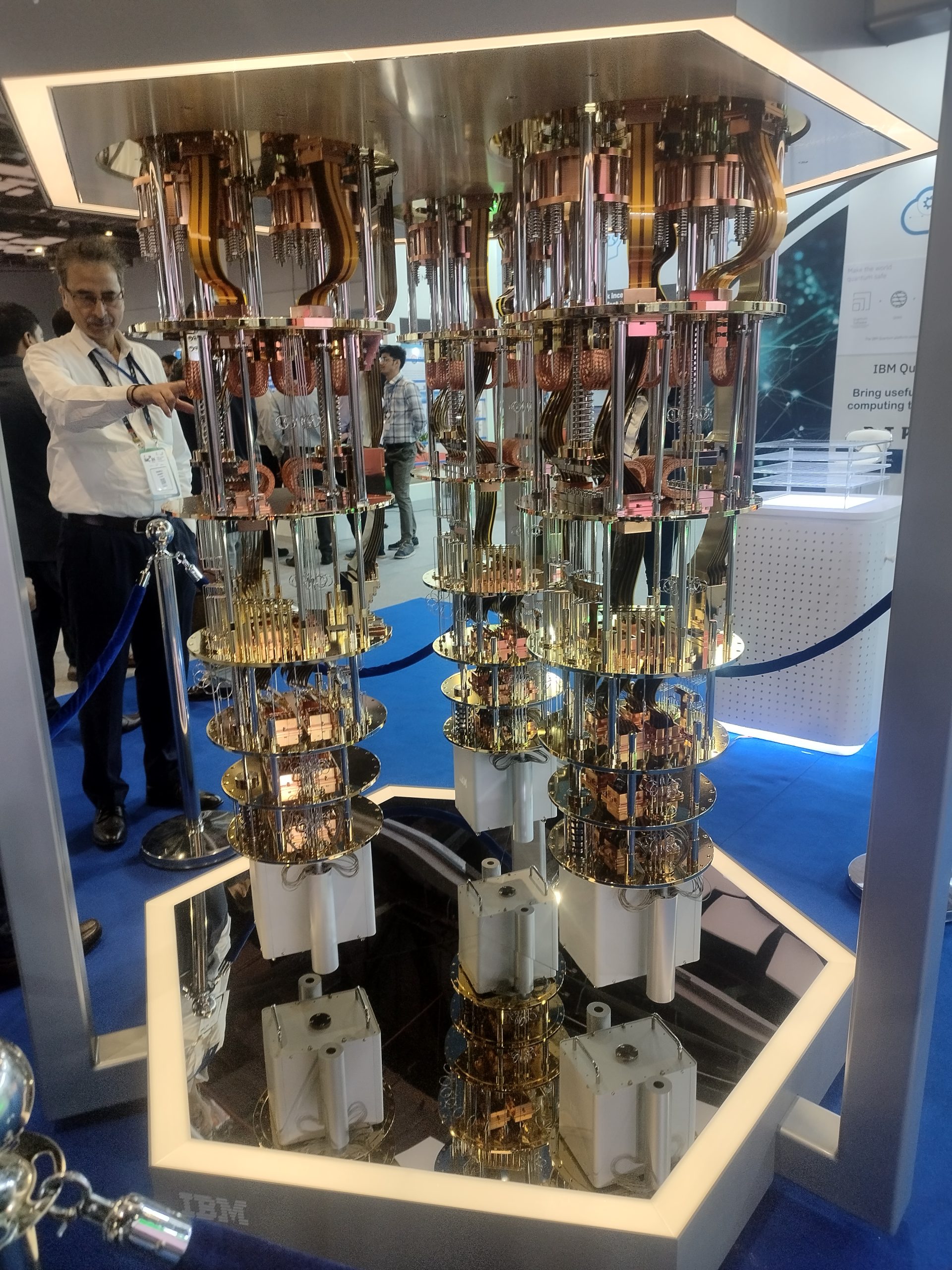
Quantum AI sits at the intersection of two of the most closely watched fields in technology: quantum computing and artificial intelligence. In broad terms, it refers to the use of quantum computers to enhance, accelerate, or reimagine the way machine-learning systems are built and run — and, in the other direction, the use of AI to help design and control notoriously fragile quantum hardware. The goal is not a single product but a research frontier: solving problems that are impractical for today’s classical computers, even the most powerful ones.
The building blocks
Classical computers process information in bits, each either a 0 or a 1. Quantum computers use quantum bits, or qubits, which exploit two properties of quantum mechanics. Superposition allows a qubit to represent a blend of 0 and 1 at the same time, while entanglement links qubits so that the state of one is correlated with another. Together, these properties let a quantum machine explore an enormous number of possibilities in parallel, which is why certain classes of problems could, in theory, be solved dramatically faster.
Applied to artificial intelligence, this has given rise to a subfield often called quantum machine learning. The idea is that quantum systems might speed up the heavy mathematical work behind AI — optimization, sampling, and searching through vast solution spaces — that underpins everything from pattern recognition to large-scale model training.
Why it matters
The promise of quantum AI lies in problems where the number of possible combinations grows faster than any classical machine can handle. Researchers point to several areas as early candidates:
- Drug discovery and materials science, where simulating molecules and chemical reactions is naturally suited to quantum systems.
- Optimization, such as routing, logistics, and portfolio management, where the best answer must be found among astronomically many options.
- Finance, including risk modeling and the pricing of complex instruments.
- Cryptography and security, where quantum computing poses both a threat to current encryption and a path toward new, quantum-resistant methods.
Where the technology stands
Despite the excitement, quantum AI remains an emerging field. Today’s machines are described as “noisy intermediate-scale quantum,” or NISQ, devices — powerful enough to run experiments but still limited by errors, short-lived qubit states, and small qubit counts. Building fault-tolerant machines that reliably outperform classical computers on commercially useful tasks is widely seen as a multi-year, and possibly multi-decade, effort.
Major technology companies and specialized startups are investing heavily, pursuing competing approaches to hardware and racing to demonstrate a clear, practical advantage over conventional computing. In the meantime, much of the near-term value is expected to come from hybrid systems, in which quantum processors handle narrow, specialized tasks while classical computers and AI models do the rest.
A realistic outlook
For businesses and observers, the sensible posture is measured optimism. Quantum AI is unlikely to replace conventional computing or today’s AI models any time soon. But as hardware matures and error rates fall, the combination of quantum computing and artificial intelligence could open the door to breakthroughs in science, medicine, and industry that are simply out of reach today. For now, it is a field defined as much by its long-term potential as by its present-day limitations.